
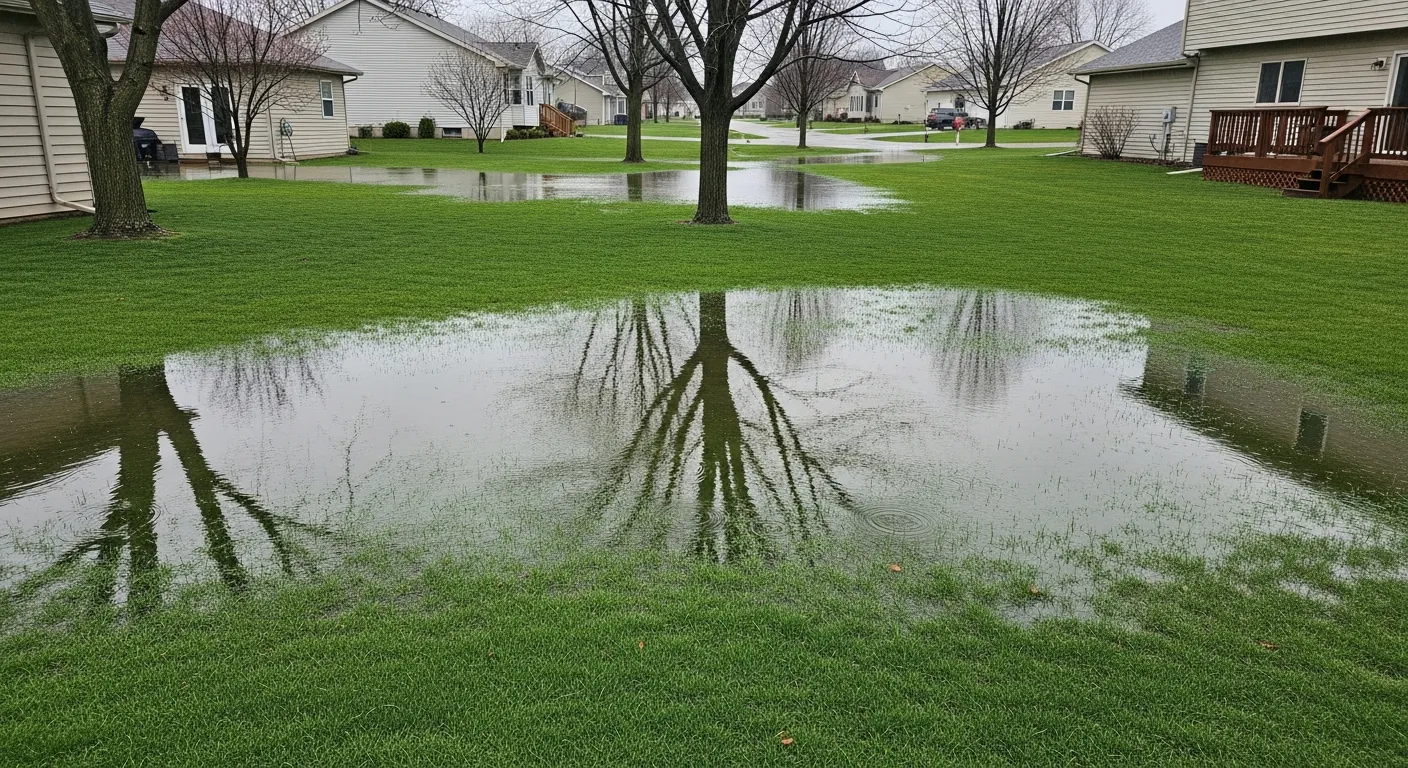
Every spring in Southwest Michigan, the same thing happens. The snow melts, the rain comes, and yards that looked fine in October turn into ponds. If you’ve got a corner of the lawn that squishes for weeks or water creeping toward your foundation, you’re not imagining it — and you’re far from alone.
The good news is that spring drainage problems are diagnosable and fixable. Here’s what’s behind them and how we solve them on local properties.
Why spring is the worst of it
A few things stack up at once this time of year:
- Snowmelt and saturated ground. The soil enters spring already full of water from winter. There’s nowhere for new rain to go.
- Frozen subsoil early on. When the deeper ground is still frozen, meltwater can’t percolate down — it sits on the surface or runs sideways.
- Heavy clay soil. Much of the Kalamazoo area sits on clay, which drains slowly even in the best conditions. Add spring volume and it backs up fast.
- Flat or poorly graded lots. Water that has nowhere to fall toward just pools where it lands.
None of these are flaws in your yard so much as facts of our region. The question is whether your property is shaped and equipped to handle them.
What the standing water is telling you
Where and how long water lingers points straight at the cause:
- Puddles that sheet across the surface during rain usually mean a grading problem — the ground isn’t sloped to carry water away.
- A spot that stays spongy for days after the surface dries points to subsurface water that needs intercepting.
- Water pooling against the foundation is the urgent one. That’s the path to a wet basement and the one we treat first.
Take a walk during the next real rain and note what you see. That observation is the first step toward the right fix.
The fixes that actually work
Regrading to move surface water
Most spring puddling is a grading issue, and reshaping the grade is the most durable fix there is. The target is simple: ground that slopes away from the house — roughly six inches of fall over the first ten feet — and no low spots left to collect runoff. Water that’s guided by gravity doesn’t need a machine to keep working.
Catch basins and yard drains
Where a low area can’t be fully graded out, a catch basin collects the water and a buried line carries it to a safe outlet. It’s a targeted tool for the specific spots that pool, and it pairs naturally with grading.
French drains for saturated ground
When water is trapped in the soil — that spongy-for-days zone — a French drain intercepts it underground and pipes it away. It’s the right answer for subsurface water, especially when you’re protecting a foundation from saturated clay.
A combined approach
Many local properties need more than one of these. We’ll often regrade to pull surface water off and away, then add a basin or French drain to handle the lowest, wettest point. Surface and subsurface water are two different problems, and a yard that has both needs both solved.
Why DIY spring fixes often fail
We get a lot of calls in May from homeowners who threw down topsoil to fill a low spot, only to watch it sink and pond again by the next storm. Filling a puddle without fixing why the water collects there just relocates the problem — or buries it until it comes back worse.
The lasting fixes work with the water: read where it comes from, shape the land to carry it away, and intercept what the surface can’t handle. That’s a reading-the-site job, not a bag-of-dirt job.
Frequently asked questions
Why does my yard flood every spring but seem fine in summer?
Spring stacks snowmelt, saturated ground, and sometimes still-frozen subsoil on top of our slow-draining clay. Summer rain hits drier, thawed ground that can actually absorb it. The yard didn’t change — the conditions did.
Can this be fixed while the ground is still wet?
We can assess it anytime, and seeing the yard while it’s wet is genuinely useful — it shows us exactly where the water goes. We’ll schedule the actual work for conditions that let us grade and compact properly.
Will fixing my yard’s grade help my basement?
Often, yes. Pulling surface water away from the foundation is one of the most effective steps for a damp basement, and it’s usually where we start.
How long does a drainage fix take?
Most residential grading and drainage jobs are a matter of days, depending on the size of the area and what’s involved. We’ll give you a clear timeline with the quote.
Get ahead of next spring’s puddles
If your yard turns into a swamp every spring, it’s a solvable problem — and the best time to fix it is before the next thaw. Tell us where the water collects or call (269) 230-1777, and we’ll put together a drainage plan built for Southwest Michigan ground.
Sources: Projul French Drain & Yard Drainage Guide, Highlands Landscaping — Grading vs French Drains.