
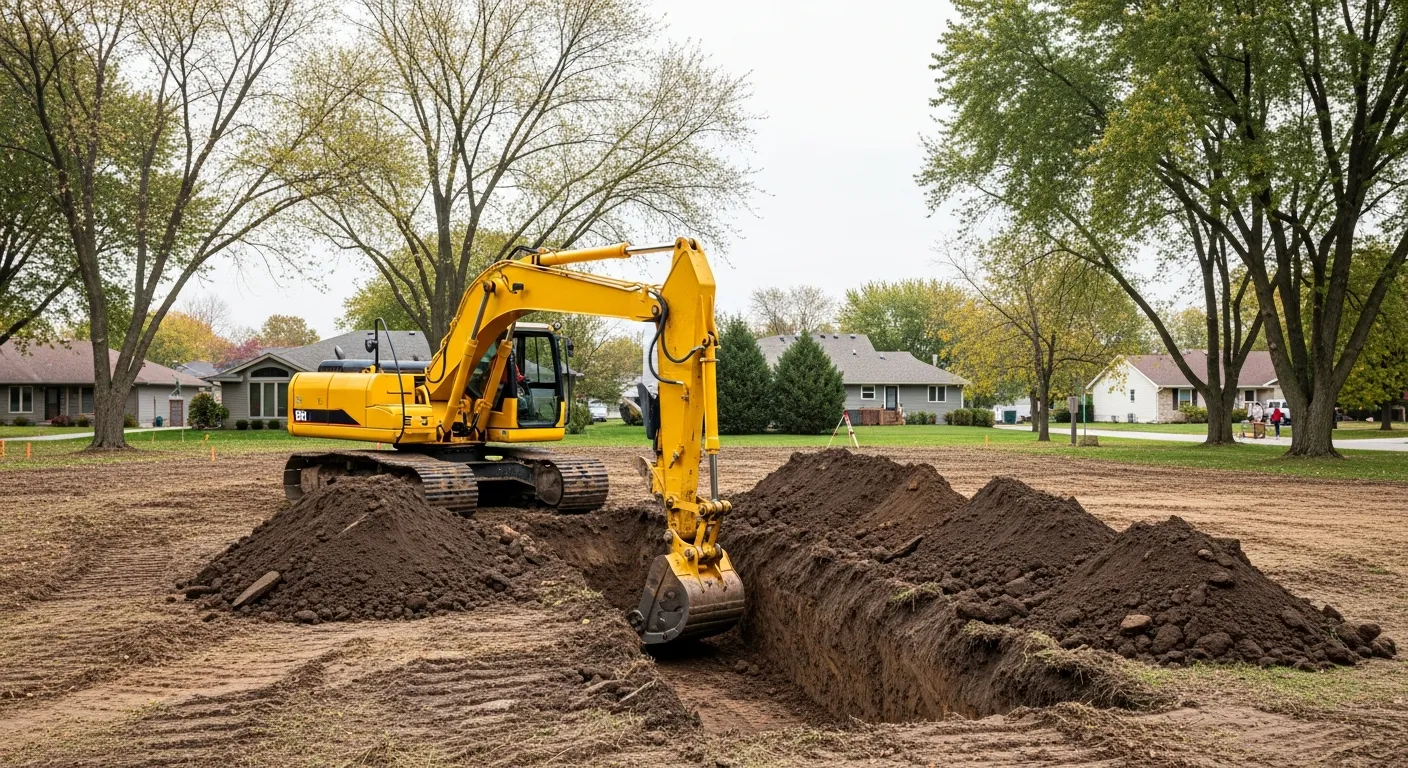
The first question almost every homeowner asks us is a fair one: what is this going to cost? And the honest answer is that excavation pricing depends on what’s in the ground, how much of it has to move, and where it goes when it leaves. Two driveways on the same street can carry very different price tags once you account for soil, slope, and access.
This guide breaks down the real numbers we see across Kalamazoo, Portage, Mattawan, and the rest of Southwest Michigan in 2026, so you can budget with your eyes open before you ever pick up the phone.
The short version: typical excavation price ranges
Nationally, excavation runs roughly $2.50 to $15.00 per cubic yard, with most residential jobs landing between $1,100 and $5,600 total. The wide spread isn’t contractors guessing — it reflects how different one site is from the next.
A few benchmarks worth knowing:
- Cut work (digging) in workable soil: about $11–$21 per cubic yard.
- Fill, grading, and compaction: usually runs higher than cut, around $13–$25 per cubic yard, because it takes more passes to get density right.
- Hauling spoil off-site: roughly $8–$25 per cubic yard, depending on trucking distance and dump fees.
- Minimum project fees: many excavation outfits set a floor of $500–$800 to mobilize equipment.
One regional note: the Midwest tends to run about 20% above the lowest-cost parts of the country for cut work. Our clay-heavy soils are part of the reason — they’re tougher to move and slower to compact than sandy ground.
What you’ll pay for common projects
Every job is quoted on its own, but here are the ballparks homeowners ask about most:
- Driveway excavation and prep: roughly $1,000–$2,500, typically including grading and compacting the base. If we’re removing and replacing an old driveway, demolition and haul-out get added on top.
- Grading a yard or building lot: commonly $1,000–$5,000, climbing fast when there’s a big elevation difference between the high and low points.
- Site prep for a slab or addition: depends entirely on square footage and how much sub-base correction the concrete and asphalt prep needs.
The five things that move your price
When we walk a site, these are the factors that decide where you land in those ranges.
1. Volume of material
Excavation is priced by the cubic yard for a reason — the more dirt that moves, the more it costs. A shallow drainage trench and a full basement dig are different universes of volume.
2. Soil type
Sandy loam digs fast. The heavy clay common around Kalamazoo digs slower, sticks to the bucket, and needs more care to compact. Hit rock or a high water table and the equipment and time both change.
3. Access and obstacles
Can a full-size excavator reach the work, or does the job call for compact equipment squeezing through a side yard? Trees, fences, septic fields, and tight lots all add time, and time is the real cost driver in earthwork.
4. Hauling and disposal
If we’re trucking spoil away or bringing clean fill in, distance to the pit or dump matters. Sometimes we can balance cut and fill on-site and save you the trucking entirely.
5. What’s already underground
Old footings, buried debris, forgotten fuel tanks, and unmarked utilities all surface mid-dig more often than you’d think. A good contractor plans for the unexpected instead of being blindsided by it.
Why the cheapest quote often costs the most
Excavation is the part of a project that gets buried — literally — so it’s tempting to shop on price alone. The problem is that a weak base doesn’t announce itself until your concrete cracks, your driveway settles, or water finds your foundation a year later. At that point you’re paying twice: once to tear out the failure and again to do it right.
The savings that matter come from accurate grade control, proper compaction, and clean drainage planning the first time — not from a number that looks good on paper and falls apart in the ground.
How to get an accurate excavation quote
A trustworthy estimate comes from a set of eyes on your actual site, not a phone guess. When you reach out, it helps to have a few things ready:
- A rough idea of the project scope (driveway, drainage, foundation, clearing).
- Photos of the area and any obvious slope or water issues.
- Whether you’ve already had utilities located, or need us to coordinate it.
From there we walk the site, check the soil and grade, and give you a clear, itemized price — no vague hourly hand-waving.
Frequently asked questions
Do you charge by the hour or by the job?
For most residential work we quote a defined scope so you know the number up front. Open-ended hourly billing makes it impossible to budget, and we’d rather you know what you’re signing.
Is the estimate free?
Yes. We come out, look at the site, and give you a written quote at no cost.
Will my soil really change the price that much?
It can. The difference between clean, workable soil and saturated clay with buried debris is real money in equipment time and compaction effort. That’s exactly why we look before we quote.
How far in advance should I book?
Spring and early summer fill up fast in Southwest Michigan. If your project has a deadline — a pour date, a builder’s schedule — reach out a few weeks ahead when you can.
Get a real number for your project
Ballpark ranges are useful for planning, but the only price that matters is the one for your site. Tell us about your project or call (269) 230-1777, and we’ll come out, walk the ground, and give you a straight quote with no surprises buried in it.
Sources: Angi 2026 Excavation Cost Guide, HomeGuide Excavation Cost.