
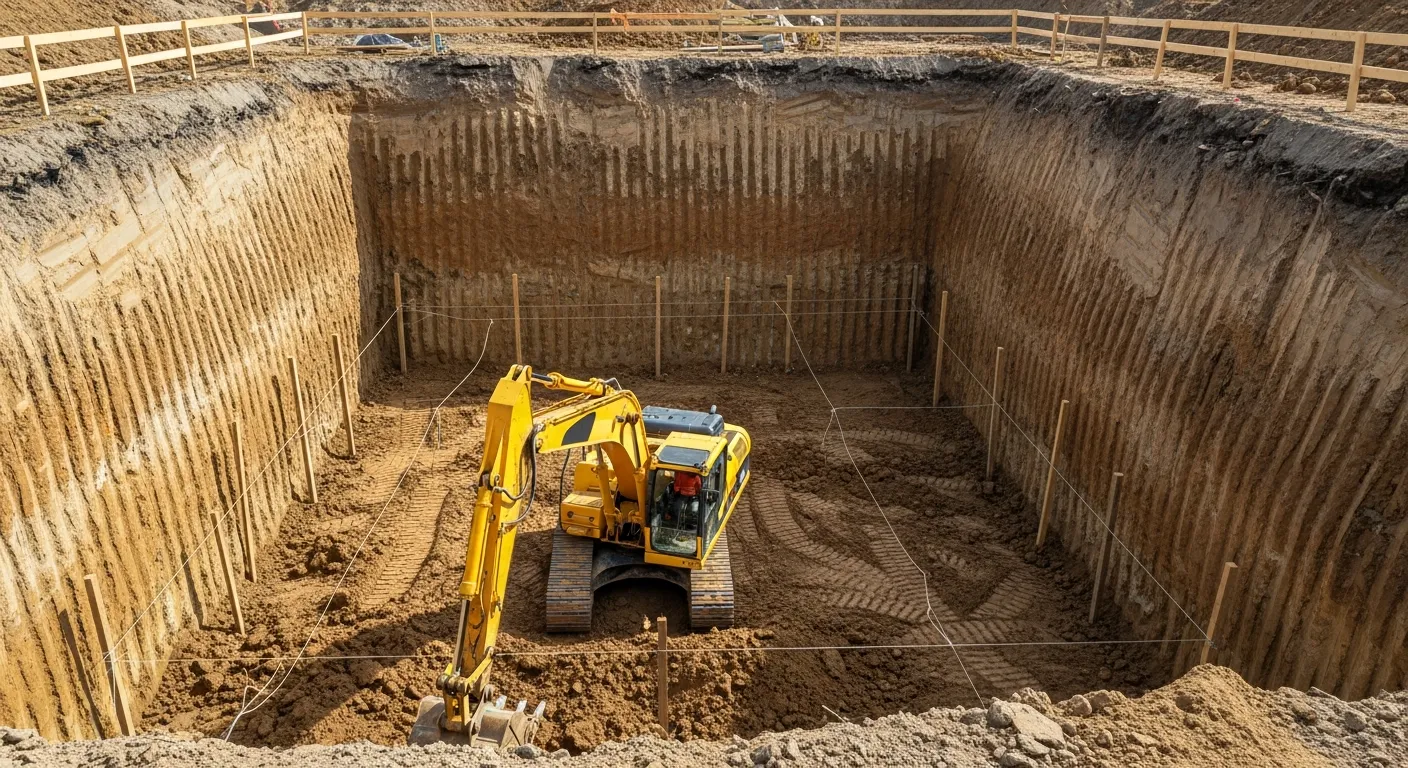
A basement is the most consequential hole you’ll ever pay to have dug. Everything above it — the foundation, the framing, the house — depends on that excavation being the right depth, the right footprint, and stable enough to build on. It’s also the stage where rushing or cutting corners causes the most expensive problems later.
If you’re planning new construction or an addition in Southwest Michigan, here’s what the basement excavation process actually looks like, start to finish.
It starts before the digging
Good excavation is mostly planning. Before a bucket touches the ground:
- Layout and survey. Property corners and the foundation footprint get established and staked so we dig in exactly the right place to exactly the right dimensions.
- Utility locating. We call MISS DIG 811 at least three business days ahead so every underground utility — gas, electric, water, communications — is marked before we start. In Michigan this isn’t a courtesy; it’s the law.
- Access and spoil planning. We figure out how equipment reaches the site, where excavated soil goes, and whether cut and fill can be balanced on-site to save trucking.
The work that prevents disasters happens here, on paper and with paint, before the dig.
How deep a basement actually goes
This is where Michigan’s climate sets the rules. Two numbers drive the depth:
- Frost depth. Around here the frost line runs deep — commonly cited near 42 inches. Footings have to bear below the frost line, or seasonal freezing heaves the foundation. This is why crawl-space and slab regions to the south get away with shallower work and we don’t.
- Usable basement height. A standard 8-foot basement means excavating roughly 9.5 to 10.5 feet below finished floor once you account for the footing depth, footing thickness, the wall bearing, the slab, and the gravel base beneath it.
We also over-dig the perimeter — a working margin of a few feet around the footprint — so there’s room to form the walls and waterproof them from outside. The hole is always bigger than the house for a reason.
Working with Michigan’s soil
Southwest Michigan’s clay is strong to build on but slow to drain and prone to holding water. That shapes how we excavate:
- We keep excavation walls stable and watch for sloughing, especially in saturated spring ground.
- We manage water in the hole so the subgrade stays workable.
- We prep the base so the footing and slab sit on clean, compacted material — not soft, disturbed soil.
A high water table or a wet season changes the approach, and an experienced crew plans for it instead of being surprised by it.
What “foundation-ready” means
The goal of basement excavation isn’t just a hole — it’s a hole your concrete crew can build in immediately. Foundation-ready means:
- Correct depth and footprint, to the tolerances your builder needs.
- A clean, compacted base for footings and slab, with no soft or organic pockets.
- Stable, safe walls and clear access for the forming crew.
- Drainage considered from the start, so water has a plan before the foundation goes in.
When we hand off a foundation-ready site, the next trade shows up and gets straight to work. No regrading, no surprises, no waiting on corrections.
Coordinating with your builder
A basement dig doesn’t happen in isolation — it’s one link in a build schedule. We coordinate timing and tolerances with your construction team so the excavation is ready exactly when the foundation crew is, and built to the dimensions they’re expecting. On tight lots, we plan equipment movement ahead of time so constrained access doesn’t stall the job.
That coordination is quietly one of the most valuable things an excavation contractor brings. The dig that’s right and on schedule keeps your whole project moving.
Frequently asked questions
How long does basement excavation take?
For a typical residential basement, the dig itself is usually a few days, depending on size, soil, access, and weather. We’ll give you a realistic timeline with your quote and keep your builder in the loop.
What if you hit water or unstable soil?
It happens, especially in spring. We manage water in the excavation and stabilize as needed to keep the base workable. Planning for it is part of the job — an experienced crew expects the unexpected.
Do you handle the utility locating?
Yes. We coordinate the MISS DIG 811 locate so everything underground is marked before we dig. It’s required by Michigan law and it’s non-negotiable on our jobs.
Can you work on a tight lot?
Yes. We plan equipment movement and spoil placement for constrained access, which is common on infill and replacement sites around Kalamazoo.
Build on a basement done right
A foundation is only as good as the excavation under it. If you’re planning a new basement or addition in the Kalamazoo area, tell us about your build or call (269) 230-1777, and we’ll dig you a stable, accurate, foundation-ready site your builder can count on.
Sources: Superior Excavating — Foundation Excavation in Michigan, 2021 Michigan Building Code §1809.5 Frost Protection.